Foundational Methodology
The STRT Model
Developed by Dr. Martin Kaufmann, PhD, LPC-S, and brought to life through ReBuild alongside co-creators Eli Varney, LPC, and Josh Hudnall, the Sub-perceptual Tendency Resolution and Transformation (STRT) Model is a first-of-its-kind integrative methodology that brings together neuroscience, psilocybin-assisted therapy, the Enneagram, and modern therapeutic frameworks into a single, coherent, and clinically rigorous operating system. STRT is designed to produce real transformation, predictably, measurably, at the foundational level.
The Model
A Groundbreaking System for Clinicians and Clients
"STRT is not a loose mixture of theories. It is a coherent system that gives neuroscience, modern therapy, and psilocybin-assisted work an organized, clinically useful structure and makes transformation predictable rather than accidental."
STRT is an emerging next-generation model of therapy and transformation. It is clinically sophisticated, neuroscience-informed, and designed for practitioners and individuals who require more than symptom management, who require a system capable of producing lasting, verifiable change at the level of identity, pattern, and neurological functioning.
STRT Is Defined By
Clinically sophisticated
Neuroscience-informed
Trauma-aware
Integration-focused
Predictive in its structure
Practical in its application
Spiritually and existentially open
Designed for real transformation, not symptom management alone
The STRT Structure
The Perceptual Threshold
At the core of STRT is the Perceptual Threshold. This is the boundary between the reactive coping loop and true transformation. Above the threshold, unresolved internal activation drives a repeating maladaptive coping loop. Below the threshold lies the transformational pathway, where lasting change becomes possible.
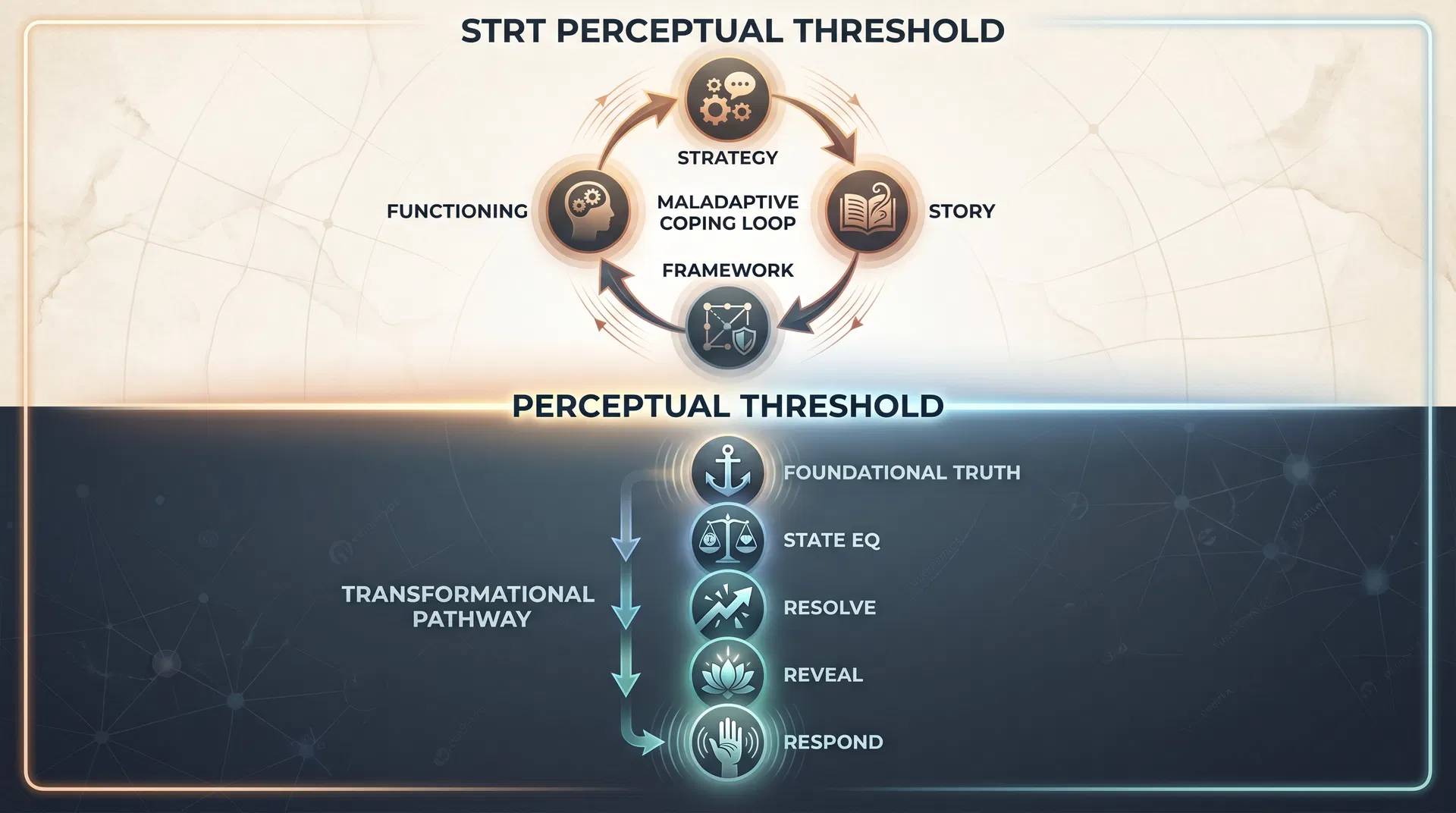
Above the Threshold
Maladaptive Coping Loop
Unresolved internal activation, narrative, and coping frameworks drive repeating behavioral patterns. The person is reactive, story-driven, and unable to access the deeper material required for change.
Below the Threshold
Transformational Pathway
Access to Foundational Truth, State EQ, Resolve, Reveal, and Respond. The five STRT domains that produce lasting, verifiable change at the level of identity, pattern, and neurological functioning.
The Central Mechanism
State EQ: The Engine of the STRT Model
At the center of the STRT Model is State EQ — the capacity to recognize, regulate, and resolve internal activation states before they drive behavior. State EQ is not emotional intelligence in the conventional sense. It is a precise, trainable skill set that enables the individual to interrupt the automatic link between internal state and behavioral response.
Without State EQ, insight remains conceptual. The person understands their patterns intellectually but cannot interrupt them in the moment. With State EQ, transformation becomes operational — the individual gains the neurological and psychological capacity to respond from truth rather than react from survival.
State EQ is developed across the ReBuild cohort experience through a combination of somatic awareness training, psilocybin-assisted sessions, and the structured application of the STRT framework. It is the mechanism that makes the other four STRT domains accessible and actionable.
The Five STRT Domains
Foundational Truth
The deepest layer of self-knowledge — the bedrock from which all lasting change originates.
State EQ
The capacity to recognize and resolve internal activation before it drives behavior.
Resolve
Addressing unfinished emotional and relational material that sustains the coping loop.
Reveal
Surfacing meaning, purpose, and direction that has been obscured by the coping loop.
Respond
Establishing a new, truth-based behavioral pattern in place of the reactive coping loop.
Integration Architecture
The Four Pillars of STRT
STRT does not borrow loosely from existing frameworks. It integrates four distinct bodies of knowledge into a single, coherent operating system, each contributing a specific and necessary dimension to the transformation process.
01
Neuroscience
STRT is grounded in a rigorous understanding of brain-based functioning, nervous system regulation, and sub-perceptual tendencies. The model accounts for state-based processing, predictive patterning, and the ways in which brain and body states shape perception, meaning-making, behavioral decisions, and relational dynamics. Transformation in STRT is not conceptual, it is neurological.
02
Psilocybin-Assisted Therapy
STRT is uniquely structured to work alongside psilocybin-assisted therapy as a deliberate, sequenced clinical tool, not a source of random insight. Three progressive sessions within the cohort experience use psilocybin to reveal deeper truths, interrupt maladaptive coping loops, and catalyze neuroplasticity in support of lasting change.
03
Modern Therapy Models
STRT integrates and organizes insights from Internal Family Systems, Narrative Therapy, Choice Theory, ACT, CBT, REBT, DBT, Polyvagal Theory, and Interpersonal Neurobiology. The Enneagram serves as an additional interpretive framework for identifying motivational styles, protective tendencies, and relational patterns. STRT is not a loose mixture of these approaches, it is a coherent system that gives them organized, clinically useful structure.
04
Predictive Methodology
STRT functions as a concise predictive methodology. By mapping how unresolved states, narratives, and coping frameworks shape behavioral probabilities, clinicians and clients gain the ability to anticipate patterns before they recur. The model moves the person from reactive coping, driven by story and survival functioning, into truth-based responding grounded in state awareness and resolution.
The Team Behind the Model
Meet the ReBuild Clinical Team
The STRT Model is brought to life by a team of three clinicians with combined decades of experience in neuroscience, psilocybin-assisted therapy, and behavioral transformation.